The Basset Hound is a short-legged breed of dog of the hound family. They are scent hounds, bred to hunt rabbits by scent. Their sense of smell for tracking is second only to that of the Bloodhound. The name Basset is derived from the French word bas, meaning "low", with the attenuating suffix -et, together meaning "rather low". Basset hounds are commonly brown and black and most often spotted, but also exist in a variety of colors.
Appearance
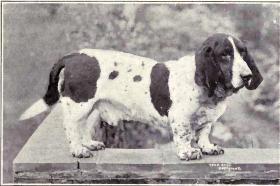
These dogs are around 1-foot in height at the withers. They usually weigh between 35 and 70 lb (16 and 32 kg). They have smooth, short-haired coats but a rough haired hound is possible. Although any hound colour is considered acceptable by breed standards, Bassets are generally tricolor (black, tan, and white), open red and white (red spots on white fur), closed red and white (a solid red color with white feet and tails), Honey And White (honey coloured back, light brown spotty nose and legs, light brown tails with white tip) and lemon and white. Some Bassets are also classified as gray or blue; however, this colour is considered rare and undesirable. They have long, downward ears and powerful necks, with much loose skin around their heads that forms wrinkles. Their tails are long and tapering and stand upright with a curve. Tails usually have white tips so the dogs are more easily seen when hunting/tracking through large bushes or weeds. The breed is also known for its hanging skin structure, which causes the face to occasionally look sad; this, for many people, adds to the breed's charm. The dewlap, seen as the loose, elastic skin around the neck, and the trailing ears, help trap the scent of what they are tracking.
The Basset Hound is a large dog with short legs. They were originally bred to have osteochondrodysplasia, known as dwarfism. Their short stature can be deceiving; Bassets are surprisingly long and can reach things on table tops that dogs of similar heights cannot. However, because Bassets are so heavy and have such short legs, they are not able to hold themselves above water for very long, and should never be made to swim.
Temperament
The Basset Hound is seen as an especially friendly breed. For this reason they are an excellent pet for children. Many Bassets "forget" the training when a reward is not present. Bassets should be on a leash when out on walks.
Bassets are known to be a vocal breed. Bassets might howl or bark when they want something or to suggest that they think something is wrong (like a storm is coming). They also use a low, murmuring whine to get attention, which sounds to many owners as though their Bassets are "talking." This whine is also used by the hound to beg (for food or treats) and varies in volume depending on the nature of the individual hound and length of time it has been begging.
Showing posts with label Hound. Show all posts
History of Basset Hound
Basset Hounds are a cross between the Bloodhound, the Regular Artisien Normand, and the Basset Artésien Normand. The first application of the word "Basset" to a breed of dog can be traced to La Vénerie, an illustrated text on hunting written by Jacques du Fouilloux in 1561. Fouilloux illustrates wire-haired bassets resembling the modern Basset Fauve de Bretagne. In Fouilloux's treatise, bassets are used to pursue foxes and badgers to ground, after which the quarry is dug from its burrow and so reduced to possession.
Other early French Bassets closely resembled the Basset Artésien Normand, which is still a breed today. The Basset Artesian Normand is one of the two recognized French Basset breeds. Originating in Artois and Normandy, it dates back to the 17th century. The Basset Artesian Normand looks like a Basset Hound, but lighter in weight. A short, straight legged hound, its body is twice as long as it is high. Its head is dome-shaped and powerful with hairy cheeks. The neck is slightly dewlap and the muscles are smooth with a moderate amount of wrinkles. The chest is round with clearly visible sternum. The coat is very short, bicolor: tan and white, or tricolor: tan, black and white. Breeders prefer white feet.
By the turn of the 20th century, the Basset Artesian Normand was developing into two distinct lines, straight-legged hunters and crocked-legged, droopy-eared companion and show dogs. French breeder Leon Verrier developed today's standard, which blends attributes of both varieties. The Artesian Basset needed straight legs that would neither hinder his speed nor drain his energy in order to work in unruly terrain, brush and briar. The breed was recognized in 1911.
Because many short-legged dogs from this time were called Basset and record-keeping from this time was sparse, it is difficult to speculate which of these breeds have bloodlines in common with today's Basset Hounds. It is commonly believed that Marquis de Lafayette brought Basset Hounds to the United States as a gift to George Washington.
In France, basset hounds achieved noticeable public cultural popularlity during the reign of Emperor Napoleon III (r. 1852-1870). In 1853, Emmanuel Fremiet, "the leading sculptor of animals in his day" exhibited bronze sculptures of Emperor Napoleon III's basset hounds at the Paris Salon. Ten years later, in 1863, the Basset Hound reached international fame at the Paris Dog Show. At that time there were two common Bassets, those with a rough coat (Basset Griffon) and those with smooth (Basset Français). The dogs were further classified by the length of their legs. The two popular Basset breeders at this time were M. Lane and the Count Le Couteulx.
In 1866, Lord Galway imported a pair of Le Couteulx Bassets to England, but it was not until 1874 that Basset Hounds were widely introduced there by Sir Everett Millais. The Kennel Club accepted the breed in 1882 and the English Basset Hound Club was formed in 1884. The American Kennel Club first recognized Basset Hounds as a breed in 1885. In 1935, the Basset Hound Club of America was organized in the United States. The current American breed standard was adopted in 1964.
Other early French Bassets closely resembled the Basset Artésien Normand, which is still a breed today. The Basset Artesian Normand is one of the two recognized French Basset breeds. Originating in Artois and Normandy, it dates back to the 17th century. The Basset Artesian Normand looks like a Basset Hound, but lighter in weight. A short, straight legged hound, its body is twice as long as it is high. Its head is dome-shaped and powerful with hairy cheeks. The neck is slightly dewlap and the muscles are smooth with a moderate amount of wrinkles. The chest is round with clearly visible sternum. The coat is very short, bicolor: tan and white, or tricolor: tan, black and white. Breeders prefer white feet.
By the turn of the 20th century, the Basset Artesian Normand was developing into two distinct lines, straight-legged hunters and crocked-legged, droopy-eared companion and show dogs. French breeder Leon Verrier developed today's standard, which blends attributes of both varieties. The Artesian Basset needed straight legs that would neither hinder his speed nor drain his energy in order to work in unruly terrain, brush and briar. The breed was recognized in 1911.
Because many short-legged dogs from this time were called Basset and record-keeping from this time was sparse, it is difficult to speculate which of these breeds have bloodlines in common with today's Basset Hounds. It is commonly believed that Marquis de Lafayette brought Basset Hounds to the United States as a gift to George Washington.
In France, basset hounds achieved noticeable public cultural popularlity during the reign of Emperor Napoleon III (r. 1852-1870). In 1853, Emmanuel Fremiet, "the leading sculptor of animals in his day" exhibited bronze sculptures of Emperor Napoleon III's basset hounds at the Paris Salon. Ten years later, in 1863, the Basset Hound reached international fame at the Paris Dog Show. At that time there were two common Bassets, those with a rough coat (Basset Griffon) and those with smooth (Basset Français). The dogs were further classified by the length of their legs. The two popular Basset breeders at this time were M. Lane and the Count Le Couteulx.
In 1866, Lord Galway imported a pair of Le Couteulx Bassets to England, but it was not until 1874 that Basset Hounds were widely introduced there by Sir Everett Millais. The Kennel Club accepted the breed in 1882 and the English Basset Hound Club was formed in 1884. The American Kennel Club first recognized Basset Hounds as a breed in 1885. In 1935, the Basset Hound Club of America was organized in the United States. The current American breed standard was adopted in 1964.
Hunting with Bassets
The Basset Hound was bred to hunt. Its keen nose and short stature are suited to small-game hunting on foot, although many Bassets have lost their age-old skills. There are a few groups that promote hunting with bassets. The American Hunting Basset Association and the Basset Hound Club of America has been the most active in promoting the use of Bassets for rabbit hunting.
Hunting with Basset Hounds when with an organization such as the American Hunting Basset Association or the Basset Hound Club of America do not involve the killing of any animals. These organizations are merely testing the Basset Hound's skills at tracking/trailing a rabbit's scent. Each organization is different in how it functions. With the AHBA, a group of 4 to 6 hounds (cast) are given one hour to find their own rabbit and judged based upon a standard set of rules while in the BHCA two dogs are paired and then put on a rabbit track and then judged. Typically the BHCA hunting lasts a few minutes per brace, the basset pair. With both organizations, the winning dog in each brace for the BHCA or cast for the AHBA go on to compete against the other winning dogs.
Hunting with Basset Hounds as a pack is common in the Mid-Atlantic States of Maryland, Virginia, New Jersey, and Pennsylvania. Several private and membership packs exist in these states. Hunting for cotton tails and hare is the quarry of preference. There were a number of Basset Hound packs in its original home of England when the hunting of hares (see Beagling) was made illegal by the Hunting Act 2004.
Hunting a hound pack requires a staff which consists of a Huntsman and the Whipper-Ins who are responsible for order and discipline of the pack. A Field Master is in charge of the field (members of the hunt and guests) that follows behind observing the hounds work the covert. Most clubs will hunt in traditional attire of a green jacket and brush pants. Recognized clubs offer those members who have supported the pack the opportunity to wear colors on the collar to indicate rank in the club.
These packs are typically of English and French hound blood lines with a mix of AKC blood lines in some packs. The National Beagle Club hosts spring and fall field trials for basset hounds. The competition held over a 4-day period with participating packs hunting in the traditional manner in braces of up to 1 hour and 15 minutes. The pack size for each competition varies, from 3 to 7 couple.
Health
Because of the extremely long ears of Bassets they are prone to ear disease. If their ears are allowed to dangle on the ground or in food on a daily basis they are capable of developing chronic and potentially fatal ear diseases. The only recent mortality and morbidity surveys of Basset Hounds are from the UK: a 1999 longevity survey with a small sample size of 10 deceased dogs and a 2004 UK Kennel Club health survey with a larger sample size of 142 deceased dogs and 226 live dogs.
In addition to ear problems, basset hounds may also have eye issues. Because of their droopy eyes, the area under the eyeball will collect dirt and become clogged with a mucus. It is best to wipe their eyes every day with a damp cloth. This helps to lessen the build up and eye irritation.
Basset Hounds can be on the lazy side and can become overweight on their own if allowed to. They need plenty of exercise and a good diet.
Basset hounds are also prone to yeast infections in the folds around the mouth, where drool can collect without thoroughly drying out. Wiping the area with a clean, dry towel and applying talcum powder can minimize this risk.
Mortality
Median longevity of Basset Hounds in the UK is about 11.4 years, which is a typical median longevity for purebred dogs and for breeds similar in size to Basset Hounds. The oldest of the 142 deceased dogs in the 2004 UK Kennel Club survey was 16.7 years.[6] Leading causes of death in the 2004 UK Kennel Club survey were cancer (31%), old age (13%), GDV (bloat/torsion), (11%), and cardiac (8%).
Morbidity
Among 226 live Basset Hounds in the 2004 UKC survey, the most common health issues noted by owners were dermatologic (e.g., dermatitis), reproductive, musculoskeletal (e.g., arthritis and lameness), and gastrointestinal (e.g. GDV and colitis). Basset Hounds are also prone to epilepsy, glaucoma, luxating patella, thrombopathia, Von Willebrand disease, hypothyroidism, hip dysplasia, and elbow dysplasia.
Training
Training Basset Hounds can be difficult. Trainers must be persistent with this breed in order to achieve a well mannered dog. Bassets have a tendency to listen to their noses and not with their ears. While this can lead to stubbornness, it also means that they are highly motivated by food. They tend to respond well to treat-based positive reinforcement methods. Owners need to make the training process lively and entertaining to allow the Basset to learn more efficiently. Training is an on-going process with Basset Hounds.
Hunting with Basset Hounds when with an organization such as the American Hunting Basset Association or the Basset Hound Club of America do not involve the killing of any animals. These organizations are merely testing the Basset Hound's skills at tracking/trailing a rabbit's scent. Each organization is different in how it functions. With the AHBA, a group of 4 to 6 hounds (cast) are given one hour to find their own rabbit and judged based upon a standard set of rules while in the BHCA two dogs are paired and then put on a rabbit track and then judged. Typically the BHCA hunting lasts a few minutes per brace, the basset pair. With both organizations, the winning dog in each brace for the BHCA or cast for the AHBA go on to compete against the other winning dogs.
Hunting with Basset Hounds as a pack is common in the Mid-Atlantic States of Maryland, Virginia, New Jersey, and Pennsylvania. Several private and membership packs exist in these states. Hunting for cotton tails and hare is the quarry of preference. There were a number of Basset Hound packs in its original home of England when the hunting of hares (see Beagling) was made illegal by the Hunting Act 2004.
Hunting a hound pack requires a staff which consists of a Huntsman and the Whipper-Ins who are responsible for order and discipline of the pack. A Field Master is in charge of the field (members of the hunt and guests) that follows behind observing the hounds work the covert. Most clubs will hunt in traditional attire of a green jacket and brush pants. Recognized clubs offer those members who have supported the pack the opportunity to wear colors on the collar to indicate rank in the club.
These packs are typically of English and French hound blood lines with a mix of AKC blood lines in some packs. The National Beagle Club hosts spring and fall field trials for basset hounds. The competition held over a 4-day period with participating packs hunting in the traditional manner in braces of up to 1 hour and 15 minutes. The pack size for each competition varies, from 3 to 7 couple.
Health
Because of the extremely long ears of Bassets they are prone to ear disease. If their ears are allowed to dangle on the ground or in food on a daily basis they are capable of developing chronic and potentially fatal ear diseases. The only recent mortality and morbidity surveys of Basset Hounds are from the UK: a 1999 longevity survey with a small sample size of 10 deceased dogs and a 2004 UK Kennel Club health survey with a larger sample size of 142 deceased dogs and 226 live dogs.
In addition to ear problems, basset hounds may also have eye issues. Because of their droopy eyes, the area under the eyeball will collect dirt and become clogged with a mucus. It is best to wipe their eyes every day with a damp cloth. This helps to lessen the build up and eye irritation.
Basset Hounds can be on the lazy side and can become overweight on their own if allowed to. They need plenty of exercise and a good diet.
Basset hounds are also prone to yeast infections in the folds around the mouth, where drool can collect without thoroughly drying out. Wiping the area with a clean, dry towel and applying talcum powder can minimize this risk.
Mortality
Median longevity of Basset Hounds in the UK is about 11.4 years, which is a typical median longevity for purebred dogs and for breeds similar in size to Basset Hounds. The oldest of the 142 deceased dogs in the 2004 UK Kennel Club survey was 16.7 years.[6] Leading causes of death in the 2004 UK Kennel Club survey were cancer (31%), old age (13%), GDV (bloat/torsion), (11%), and cardiac (8%).
Morbidity
Among 226 live Basset Hounds in the 2004 UKC survey, the most common health issues noted by owners were dermatologic (e.g., dermatitis), reproductive, musculoskeletal (e.g., arthritis and lameness), and gastrointestinal (e.g. GDV and colitis). Basset Hounds are also prone to epilepsy, glaucoma, luxating patella, thrombopathia, Von Willebrand disease, hypothyroidism, hip dysplasia, and elbow dysplasia.
Training
Training Basset Hounds can be difficult. Trainers must be persistent with this breed in order to achieve a well mannered dog. Bassets have a tendency to listen to their noses and not with their ears. While this can lead to stubbornness, it also means that they are highly motivated by food. They tend to respond well to treat-based positive reinforcement methods. Owners need to make the training process lively and entertaining to allow the Basset to learn more efficiently. Training is an on-going process with Basset Hounds.
Subscribe to:
Posts (Atom)
| Basset Hound Calorie Calculator by TrainPetDog |
| Are You Sick & Tired of Do you wish that there was a simple way of house training a puppy quickly and easily? |

